Why is the choice of an international shipping method important?
In international trade, selecting a method for transporting goods is a critical decision that can impact the final cost of the product, delivery timelines, supply schedules, and the overall profitability of the transaction.
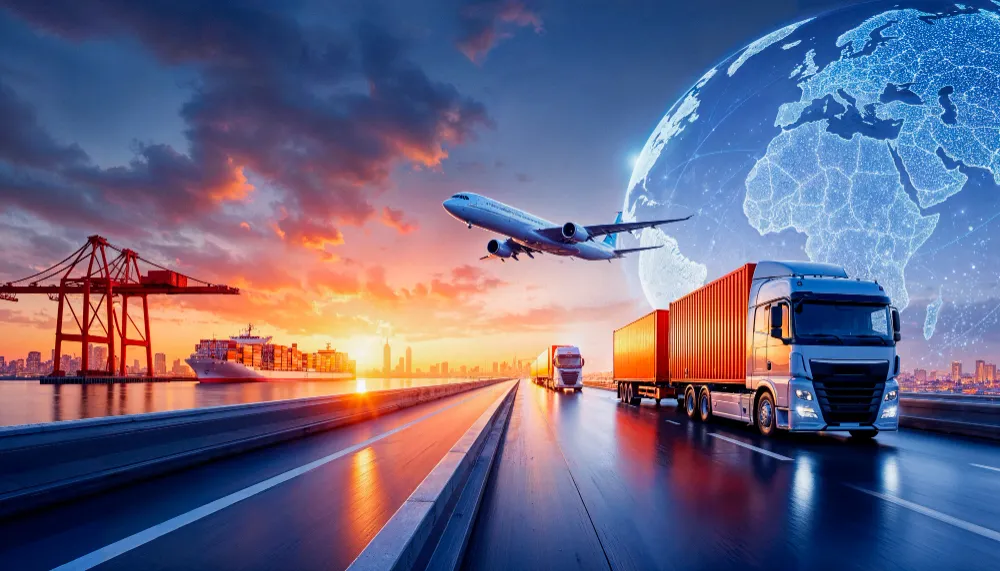
The three primary modes of international transport are air, sea, and land. Each of these methods possesses distinct characteristics, limitations, and specific use cases.
Choosing the optimal shipping method depends on factors such as the nature of the goods, their weight and volume, the origin and destination, the required timeframe, and the available budget.
Comparing Air, Sea, and Land Transport
| Feature | Air Freight | Sea Freight | Land Freight |
|---|---|---|---|
| Speed | Generally higher | Generally lower | Route-dependent |
| Cost | Generally higher | Economical for large volumes | Depends on route and mode of transport |
| Capacity | Weight and dimension limitations | Suitable for bulky cargo | Variable |
| Primary Application | Urgent and high-value cargo | Bulk and commercial cargo | Road and regional routes |
| Route flexibility | Dependent on airport network | Dependent on ports | Dependent on road network |
| Type of Goods | Goods suitable for air transport | Containerized and bulk | Commercial, industrial, and specialized |
This is a general comparison; the actual cost and time for each method must be evaluated based on the specific route and the characteristics of the shipment.
Air Freight: Suitable for Urgent Shipments
Air freight becomes particularly important when the delivery timeline is a critical factor.
For instance, if a factory requires a specific part to continue operations—and that part is currently out of stock—any delay in its arrival could result in significant costs. In such scenarios, paying a premium for air freight may be economically justified.
Air freight is also a viable option for commercial samples, high-value goods, and time-sensitive shipments.
Key Advantage: High transit speed.
Key Limitation: Higher costs on many routes, as well as weight and volume restrictions.
Sea Freight: Suitable for Bulk Shipments
Sea freight is typically a primary option for transporting large volumes of goods in international trade.
Containerized shipments, raw materials, industrial equipment, and large volumes of commercial goods can be transported via sea routes.
In this method, the choice between Full Container Load (FCL) and Less than Container Load (LCL) depends on the volume of the shipment.
Main advantage: Ability to transport large volumes and high capacity.
Main limitation: Longer transit times and dependence on vessel schedules, ports, and port operations.
Land Transport: Suitable for Road Routes
Land transport is a viable option for many regional and international routes that possess adequate road infrastructure.
In this method, selecting the appropriate type of truck is crucial. For instance, general cargo may be transported using a curtain-sided (tarpaulin) truck, whereas temperature-sensitive goods require refrigerated equipment.
Main advantage: Flexibility in routing and the ability to plan based on specific origins and destinations.
Main limitation: Dependence on road conditions, border crossings, permits, and route restrictions.
How do you choose the best method for transporting goods?
To select the appropriate method, it is best to consider the following questions:
1. How urgent is the shipment?
If the goods must reach their destination in the shortest possible time, air freight may be a suitable option.
2. What are the volume and weight of the shipment?
For large shipments, sea or land transport may be more cost-effective.
3. What are the origin and destination?
Accessibility to airports, ports, and road networks can influence the choice of transport method.
4. What is the value of the goods?
For high-value items, the cost of expedited shipping may be justified when weighed against the costs of tied-up capital or commercial delays.
5. Do the goods require special handling conditions?
Temperature-sensitive, hazardous, exceptionally heavy, or unusually sized goods may require specialized equipment and transport methods.
Is it possible to use a combination of different transport methods?
Yes. In certain logistics processes, multimodal (or combined) transport can be an appropriate choice.
For instance, goods might first be transported to a port via sea freight and subsequently reach their final destination by truck. On certain routes, a combination of air and land transport can also facilitate better delivery scheduling.
The choice of multimodal transport depends on route conditions, time constraints, costs, and the feasibility of coordinating between different transport modes.
Selecting a Transport Method with Expert Guidance
Choosing a transport method based solely on the initial price is not always the best decision. Ancillary costs, delivery timelines, the nature of the goods, and the risk of delays must also be taken into account.
Azim Tarabar International Transport Company offers air, sea, and land freight services, enabling the evaluation of various transport options tailored to each client’s specific needs.
If you are planning to import or export goods, please provide the shipment specifications, origin, destination, and required delivery timeframe so that the most suitable transport methods can be assessed.